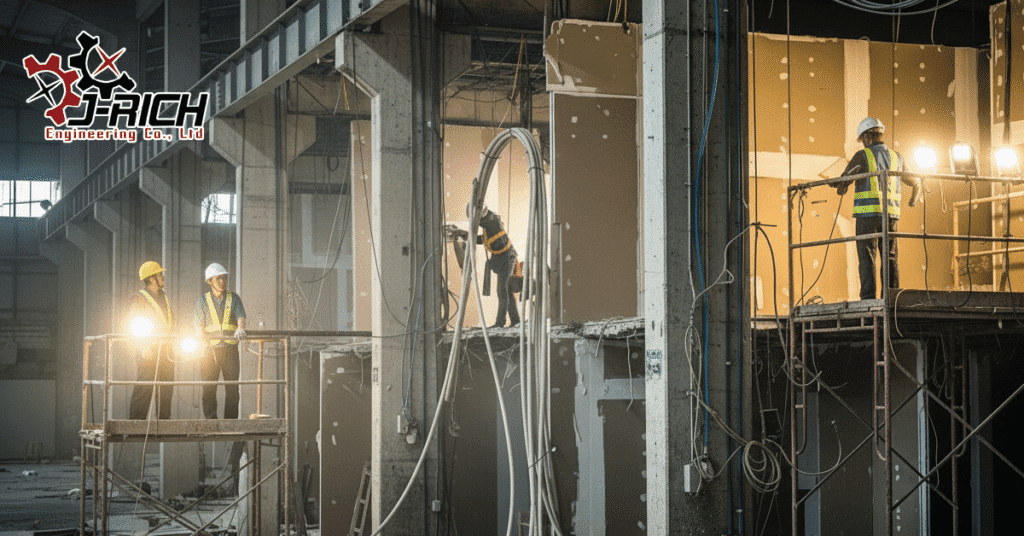
Interior demolition and building reinstatement are critical steps in the renovation or decommissioning of industrial facilities. These processes directly impact the structural safety of buildings and the readiness of spaces for future use. Both require professional planning and strict compliance with legal and safety standards to prevent accidents and ensure smooth project execution.
This article explains what interior demolition and reinstatement mean, why they are necessary, how the process works, the safety measures involved, and the legal and technological standards applied both in Thailand and abroad — including innovations such as demolition robots, dust-control systems, and BIM integration — to help building owners understand the overall significance of these works.
Definition: Interior Demolition and Building Reinstatement
Interior demolition in factories refers to removing or dismantling internal building elements without affecting the main structure — such as partitions, internal walls, electrical systems, plumbing, machines, or other installed components — in preparation for renovation or new use. It’s often the first step in any factory refurbishment project and plays a key role in clearing space for new installations.
Building reinstatement, on the other hand, means restoring a leased factory or building to its original “bare shell” condition after the tenant’s use. This involves removing temporary additions (light partitions, suspended ceilings, electrical fixtures, machine foundations, etc.) and handing the premises back to the owner in compliance with the lease agreement. Failing to reinstate properly can lead to penalties or extra costs.
Reasons and Importance of Interior Demolition
Several situations may require interior demolition in factories:
- Space modification or production-line change – When a factory revises its layout or process, internal walls, mezzanines, or obsolete machines must be removed to make way for new systems.
- Aging or unsafe structures – Deteriorated materials or corroded steel frames may need removal to prevent hazards.
- Legal or zoning compliance – Government orders may require demolition of non-conforming structures or removal of hazardous materials.
- Lease expiration (reinstatement) – Tenants must return facilities to original condition per the contract.
- Abandoned or unsafe buildings – Demolition helps eliminate public-safety risks from derelict facilities.
Neglecting proper demolition can cause delays, legal disputes, or structural accidents.
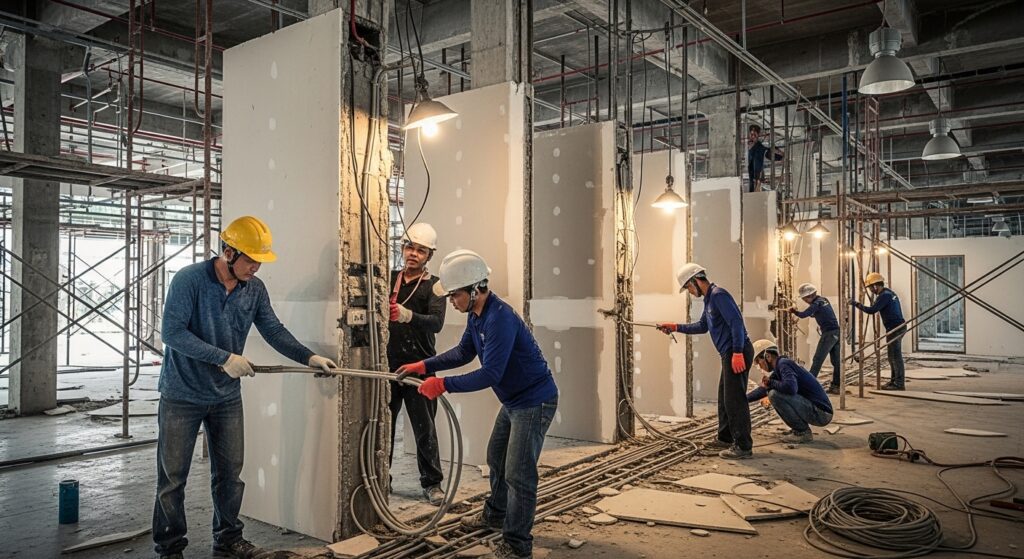
Steps and Safety Measures in Interior Demolition
- Survey and assessment – Engineers inspect the structure, utilities, and any hazardous materials (asbestos, lead, etc.).
- Permitting – In Thailand, buildings over 15 m tall or 200 m² floor area require local authority approval with supporting documents (land title, building plans, engineer certification, Form A.1).
- Site preparation and safety setup – Fence off the area, cut utilities, and provide PPE (helmets, gloves, masks, harnesses).
- Systematic demolition – Start from non-load-bearing components (ceilings, finishes) and work top-down while controlling dust, noise, and vibration.
- Waste handling – Segregate concrete, metal, wood, and hazardous waste for recycling or proper disposal. Cover trucks and clean tires before leaving the site.
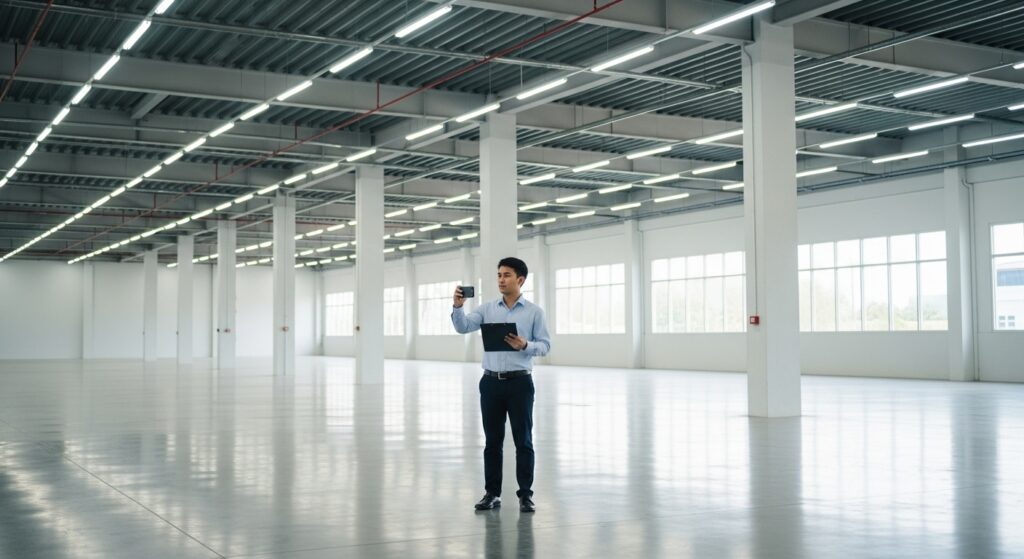
- Final inspection and cleaning – Ensure all hazards are removed, document the before-and-after condition (especially for reinstatement), and prepare the space for new construction or handover.
Special caution: Structural engineers must supervise partial demolitions to avoid collapse.
In the U.S., OSHA mandates a written Engineering Survey before demolition begins to identify risks and prevent accidents. Daily toolbox talks and emergency-response plans are also required.
Legal and Regulatory Standards
The demolition of buildings and structures is governed by legal regulations and safety standards in many countries. These frameworks are designed to ensure that demolition activities are carried out safely — protecting lives and property — while minimizing environmental impacts. The key operational guidelines and legal requirements are as follows:
Thailand
Regulated under the Building Control Act B.E. 2522 and related ministerial regulations.
Demolition of tall or large-area buildings requires a permit from the local district office or municipality; violations may incur fines up to ฿100,000 plus daily penalties.
Additional rules cover work near property lines (< 2 m), PPE use, scaffolding, public-safety barriers, and liability insurance.
United States
Governed by OSHA 29 CFR 1926 Subpart T – Demolition.
Employers must perform an Engineering Survey, remove hidden hazards (asbestos, lead, electrical lines), and follow strict PPE and waste-handling standards.
Non-compliance can lead to fines and work suspension.
Japan
Japan emphasizes environmental safety due to dense urban conditions and earthquake risks.
Innovations include:
- Taisei Tecorep System – enclosed top-down demolition reducing dust by 90%.
- Kajima Cut-and-Take-Down – bottom-up hydraulic lowering that shortens demolition of 24-story towers to 6.5 months.
Japan also enforces strict waste-separation laws promoting Zero Emission and circular-economy goals.
Europe
The EU Waste Framework Directive (2008/98/EC) targets 70% recycling of construction and demolition waste.
The Pre-Demolition Audit identifies reusable materials and hazardous substances before work starts, enabling Selective Demolition.
EU protocols mandate waste tracking, dust/noise limits, and safety planning (e.g., UK CDM Regulations).
Emerging Technologies and Trends
- Remote-controlled demolition robots (e.g., Brokk) for confined or hazardous zones improve precision and worker safety.
- BIM-based demolition planning enables 3D/4D simulations of safe dismantling sequences and structural load analysis.
- Advanced dust-control systems – mist cannons, anti-dust foams, and negative-pressure filtration with real-time air sensors.
- Reuse & Recycling (Green Demolition) – careful deconstruction to salvage steel, timber, and precast panels; concrete crushed for reuse; aligns with LEED green-building credits.
Digital project management – drones, IoT sensors, and mobile apps for real-time progress tracking, risk alerts, and remote supervision.
Conclusion
Interior demolition and building reinstatement are complex yet vital processes in industrial property management.
Success depends on engineering expertise, legal compliance, and modern safety and environmental technologies.
Proper planning — from initial surveys to waste management — ensures safety, efficiency, and minimal business disruption.
Adopting best practices from Thailand and international standards elevates the Thai construction and demolition industry toward a more sustainable and socially responsible future.
Selecting qualified, certified contractors is key to ensuring your demolition or reinstatement project is safe, legal, and efficient
References
- OSHA (USA) – Demolition Standards 29 CFR 1926 Subpart
- Omega LLC – “Advancing Demolition Technology” (2025) [ omega3llc.com ]
- Web Japan – “High-Tech Demolition Systems for High-Rises” (2013) [ web-japan.org ]
- European Demolition Association (EDA) – “EU Construction & Demolition Waste Protocol 2024 – Highlights” [ europeandemolition.org ]