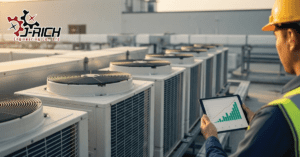

Hot season is when an air conditioning system has to work the hardest to release heat to the outside of the building.
If heat cannot be dissipated efficiently, the high-side pressure will rise. As a result, the system may shut down to protect itself from damage, making occupants feel that the air conditioner is not cooling as effectively as before.
The most common causes are insufficient airflow through the condenser coil, hot-air recirculation, or a dirty condenser coil—all of which are external to the unit.
9 Reasons Why Your Air Conditioner Doesn’t Cool as Well During Hot Season
1) Dirty condenser coil
A dirty condenser coil restricts airflow, so heat can’t be rejected fast enough. This raises pressure, makes the system trip more often, and also increases power consumption.
Signs: unusually strong hot air blowing out the back, trips during peak sunlight, or a spike in electricity bills.
2) Outdoor unit too close to a wall / blocked on multiple sides
Outdoor units need adequate clearance for air intake and discharge. If installed too close to a wall, enclosed by solid louvers, or placed in a narrow shaft, hot air can circulate back into the unit (hot-air recirculation), making it trip easily in summer.
3) Hot-air recirculation
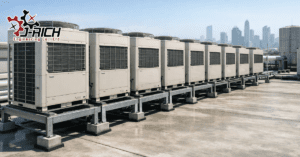
Common on rooftops where there are walls, tall fences, or many units lined up—so they end up blowing hot air at each other.
Result: some days it’s “fine,” but on extremely hot days it trips repeatedly.
4) Direct sun + rooftop heat buildup
A very hot rooftop increases ambient temperature around the unit (heat island effect), making heat rejection harder
Correct fix: install a sunshade that doesn’t block airflow (high roof, open sides).
Wrong fix: solid enclosures that stop air movement.
5) Condenser fan not running at full performance
The condenser fan is the system’s “lungs.” If airflow is weak, pressure rises—often found together with a dirty coil.
6) Dirty installation area / clutter around the unit
In hot season, strong airflow can pull nearby debris into the intake without you noticing. Buildings should enforce a clear-zone rule: no storage or objects around outdoor units.
7) Voltage drop or unstable power during peak load
During hot season, electrical demand surges. Voltage may dip or fluctuate, causing the inverter/control to shut down for self-protection.
This usually happens during specific hours (e.g., 2–5 PM). It should be measured by an electrical team, not guessed.
8) Poor schedule settings that don’t match real usage
Some buildings set start/stop times that cause a big load spike at the start of operations. The system has to ramp aggressively, increasing the chance of trips (especially in high-occupancy zones).
9) Building heat load increased, but the AC system stayed the same
Examples: more occupants, more machines, added server room load, changes to glass/ceiling/layout—making the building “hotter” while the AC capacity stays unchanged. Units then run at full load constantly, wear faster, and trip more often.

10-minute checklist (building owners can do before calling a technician)
- Is anything blocking airflow around the outdoor unit? (walls, louvers, stored items, plants)
- Is the condenser coil dirty? (thick dust, grime, lint)
- Is hot air blowing back into the air intake side?
- Are outdoor units packed too tightly and blowing hot air at each other?
- Are all fans spinning normally with normal sound?
- Does tripping correlate with the building’s peak electricity usage hours?
- Did building usage change before the problem started? (people, machines, layout)
- When was the last PM done? (before hot season or after)
- Is the temperature set extremely low (e.g., 18°C building-wide) causing nonstop heavy operation?
- Are there repeated complaints from the same floor/zone?
Best-value fixes for buildings (ranked by impact)
#1: Clean the condenser coil and clear the area for airflow (most noticeable improvement in hot season)
#2: Reposition units / increase clearances per manufacturer manual (reduces recirculation)
#3: Add a ventilated sunshade (no airflow blockage)
#4: Measure voltage during peak hours and fix electrical issues (if confirmed)
#5: Adjust schedules and zone control to avoid simultaneous load spikes
FAQ (common questions from building owners)
Q: I cleaned the AC—why does it still trip often?
A: Cleaning only the evaporator coil (indoor coil) isn’t enough. If the issue is poor condenser heat rejection, hot-air recirculation, or a stagnant/blocked installation area, it can still trip.
Q: Does adding a roof cover over the outdoor unit help?
A: Yes—if it’s open/ventilated and doesn’t block airflow. But a solid enclosure can worsen recirculation and make tripping more frequent.
References
- Dirty Condenser May Cause Poor Airflow [ achrnews.com ]
- Daikin RXYN10AY1 VRV System Air Conditioner Installation Manual [ manuals.plus ]
If your building’s AC trips frequently in hot season, cools unevenly, or the power bill spikes, consult J-Rich Engineering to survey on-site and identify external causes such as stagnant airflow zones, hot-air recirculation, improper clearances, and cost-effective correction plans.